

How To Draw Book With Fantasy Characters Cretures And Animals
Equally a fantasy writer, ane of the biggest things that attracted me to the genre was fantasy creatures. I dearest imagining new beings, mixing features and lore with ones that already be, and incorporating those creatures into my stories to spotter them collaborate with the world and characters.
If you're interested in writing fantasy or sci-fi, you're probably pretty familiar with a lot of dissimilar fantasy creatures that already be. In your own writing, do you create your own unique beings, or do you use lore monsters and classic creatures?
What are fantasy creatures?
A fantasy beast is an imagined existence, commonly for storytelling. Whether it's novels, video games, art, or spoken sociology, fantasy creatures are present in any culture you tin name. Ancient civilizations, every continent, every subcategory of place and person–they all take fantasy creatures.
The Centre-Eastern Manticore, the Cajun Rougarou, the Scottish Kelpie, the Zulu'southward Tikoloshe. Anybody has fantasy creatures. They might exist toted as fact (like creatures important for the religion or customs of different regions), or they might exist stories people tell for fun (growing upwardly in Louisiana, we were told the Rougaru would come eat children or turn them into Rougarus if they misbehaved).
Fantasy writers often pull from lore and fairytales to recreate them when writing their novels. They might also take elements of one or more than creatures to put their own spin on them. And other writers brand up their own original creatures, which is difficult to practise!
A writer would be hard-pressed to come with a completely original character that didn't seem at to the lowest degree a petty derivative of an existing brute, so don't sweat originality likewise much.
Benefits of Having Unique Fantasy Creatures in Your Novel
If you're writing a high fantasy, using epic fantasy creatures tin arrive a lot more exciting! They can also add conflict and richer worldbuilding.
Imagine if Tolkien wrote Lord of the Rings with no fantasy creatures. Just humans in a world with some magic–not as heady or interesting, correct? Adding unique animals and beings to your earth is a crucial step in edifice a compelling and immersive fantasy.
A well-crafted fantasy creature can also make your story memorable and unique. It'due south a real gamble to employ your creativity and logic to create "realistic" makebelieve.
So how exercise we create skilful fantasy creatures?
How to Create One-Of-A-Kind Fantasy Creatures
You're allowed to brand upward your own animals in your earth, ones that can do and exist whatever they please. However, if you create these fantasy creatures with intention to add together to and build your story, it'll be far more effective and memorable.
Hither'southward how to brand fantasy creatures people create fan art for:
one. Consider the fantasy earth they alive in
The surroundings, lore, history–fifty-fifty politics and religion–tin can impact the creatures that are created and exist in your world. Retrieve about what creatures would reasonably exist in the environment you've created. Would any of them be exterminated, relocated, or hunted? Are they sacred or worshipped?
Every bit an example of using the environment to shape the creatures, hither's a brusk list of creatures I used in my fantasy novel who live in the swamp environment.
- Komars. Komars are hivemind swarms of behemothic mosquito-similar creatures with scimitar claws. Mosquitos love warm, boiling places, so having a like fantasy creature in the swamp made sense for that location.
- Adelaide. Adelaide is a character who lives and works in the swamp, and she'south a scaly, amphibious person. Her biology and instinctual behavior makes her adept at surviving in an unforgiving swampscape.
- Ragondin. Ragondin is a giant mount brute who resembles a nutria rat. He's not sentient in the style humans are, but he works with Adelaide and acts as a named graphic symbol. His coarse hair, thick tail, fat mass, and loftier nostrils make him perfect for swimming in murky water for long periods of time.
- Garou. Garou is one of many swamp villains. He'southward a wolf-human hybrid. Garou is influenced past the Cajun Rougarou and acts similarly to the lore I heard growing up.
All of these creatures work together to create the world of my swamp setting, and all contribute to the vibes, themes, plots, and character arcs that happen there. If you put any of the creatures I listed in another environment in the same universe (which I do a few times in the books), they would stick out and struggle.
That's how well you want your creatures to make sense for the environs, because information technology makes for a much more believable world that your readers can really immerse themselves in.
We take a great blog post all about building a realistic fantasy world right here and then yous can go started.
2. Consider how the creatures collaborate with the characters and plot
Sympathise your creature's place in the story universe. Is your animate being its own sentient species?
Are they a friend, a pet, an enemy? What does the element of a fantasy creature add to your story, to the scene it'due south in, and to your character arcs?
How can your creature create disharmonize for a scene or plot point in your novel?
Recollect about the ways in which your fantasy animal can play a function, and non simply be a distant addition to your worldbuilding. When characters come into contact with them, it can make the world feel so much bigger and more real than if they're but observed.
iii. Build their concrete features
This is where it gets fun. You can develop the way your grapheme looks based on factors like its environment, its origin, and its purpose. You lot can pull ideas and elements from existent animals or creatures of lore and fairytales.
If you're taking a classic creature, like a vampire or an elf, what original matter can you bring to them? For example, Stephenie Meyer took vampires, introduced the concept of vegetarianism, and made them sparkle in sunlight.
At that place are benefits to taking a animate being that already exists, like a vampire, because the groundwork is already washed. Your reader knows what a vampire is. But and then they get to acquire what makes your (or Meyer'due south) vampires unique in that universe.
Hither are a few things to consider when you're crafting your fantasy beast's physiology:
- Evolution. What did previous iterations of this creature look like? Why did it develop in this way? Does it take vestigial features?
- Features. Wings, limbs, horns, tails, scales, fur–there are endless combinations of endless lists of feature elements. It can be difficult to decide! Consider what use each of these features would have for the creature and its thriving (or failure) in an environment.
- Colors and patterns. This could just be for fun, or maybe your creature survives through cover-up or other pattern-related techniques. Also consider what the colors and patterns tin can mean for the creature socially–are some considered more bonny? Are some colored specifically to attract mates?
- Size. How big is your animal? How much does information technology weigh? Can it change its shape or size? How does its size change from infancy to machismo?
- Variations and subspecies. How are members of the same species unlike from each other, and are there categorically unlike types?
- Habits, diet, etc. Knowing how your creature spends its fourth dimension can help you decide what it looks like, how information technology acts, and what information technology needs to survive and thrive.
Examples of Mystical Fantasy Creatures
Allow's await at a few examples of fantasy creatures to get some ideas flowing! You tin definitely use these in your own novels, but nosotros challenge you to call back a lilliputian broader and instead pull inspiration from the below examples and tweak them to make them unique with the tips above.
one. Phoenix
The phoenix is a mythical bird associated with Greek roots that is known for its cyclical regeneration. It ignites at the end of its life cycle, regenerating and emerging equally a new creature–sometimes equally a newborn version of itself, and sometimes as a new creature entirely. Phoenixes are where we get the cliche "rise from the ashes."
ii. Centaur
A centaur is a creature with the head, torso, and arms of a human, simply the legs and body of a horse. They also come from Greek mythology, with various possible origins, all of which involve a human breeding with a equus caballus, to confirm your fears.

3. Dragon
Anybody knows what a dragon is, because there's a version of them in every culture. This might be due to individual nations discovering the remains of dinosaurs and drawing conclusions.
An anthropologist (David E Jones) suggested that the fright of snakes is so common in humans due to an evolutionary fearfulness recognition of dragons. That might seem like a silly assertion, just consider that it's besides very fun.
4. Selkie
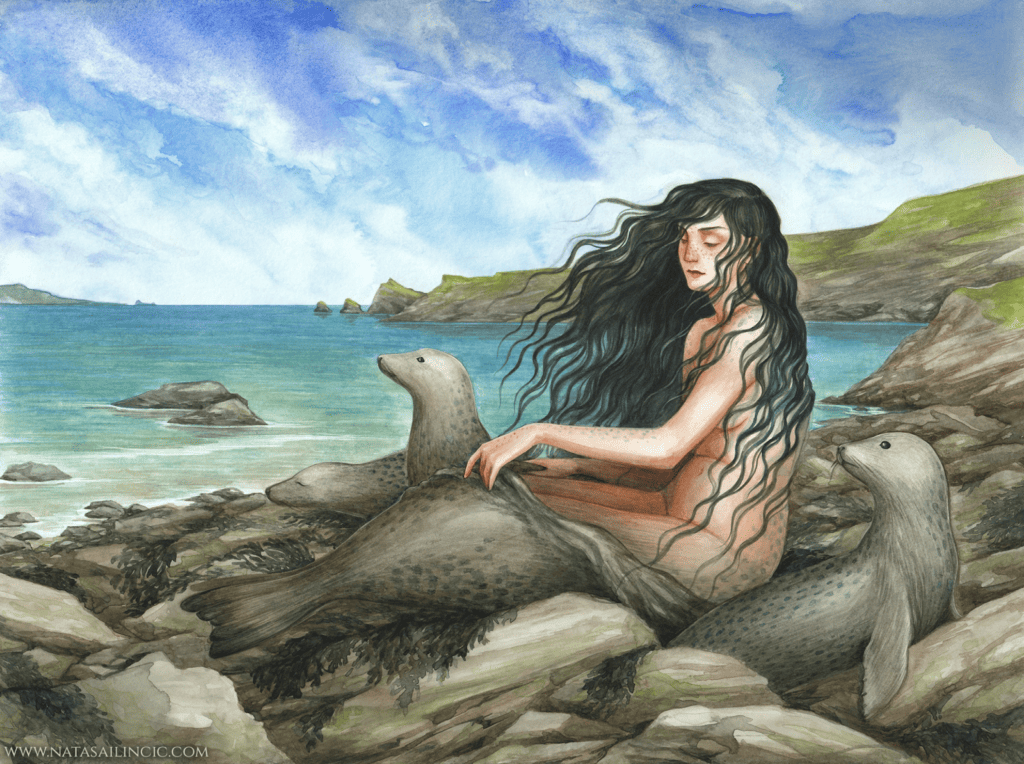
Selkies are creatures that can shift from homo class to the form of a seal. They come from Norse and Celtic mythology, featured in many stories and folktales.
The most popular stories involve a man finding the selkie'south skin (sometimes taking the course of a fur glaze or some other blazon of outerwear), hiding information technology, and forcing her to stay human and marry him (gross). Song of the Body of water is an animated film featuring a selkie character.
5. Griffin
Griffins are another hodgepodge animal, with the trunk of a lion and the wings and head of an eagle. Some griffins may besides accept hawkeye talons. The griffin is a powerful brute in mythology, considering the king of beasts and eagle are both seen as kings of the brute kingdom.
They appear in most tales equally guards of treasure or other highly valued things. Some myths include that the griffin lays its eggs surreptitious, and if y'all dig them upward, you'll detect they're surrounded by nuggets of gold. If I didn't desire people agonizing my eggs, I personally wouldn't bury them with gilt nuggets, just who am I to judge the choices of a griffin.
6. Bandersnatch
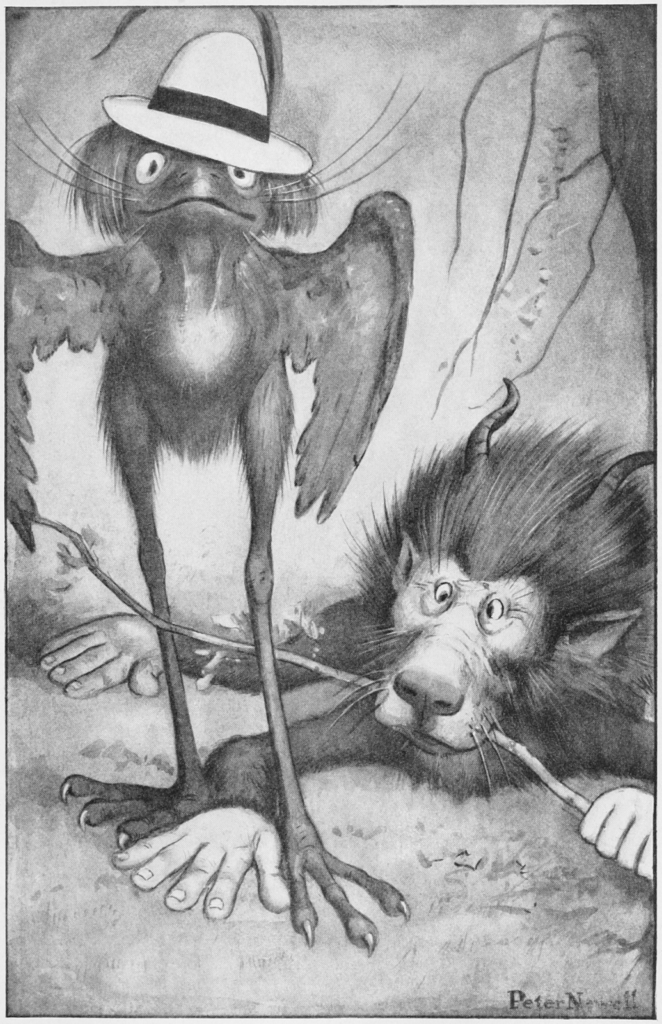
I'm including this gangly doofus considering he has a specific and articulate origin–Lewis Carroll. Carroll became famous for works like Alice in Wonderland and Through The Looking Glass. The first mention of the bandersnatch is in Carroll's verse form, Jabberwocky:
"Beware the Jabberwock, my son!
The jaws that seize with teeth, the claws that catch!
Beware the Jubjub bird, and shun
The frumious Bandersnatch!"
7. Mermaid
Everyone knows what a mermaid is considering, just similar the dragon, in that location are iterations of the mermaid myth in most every civilisation. With the tail of a fish and the torso of a human, the mermaid has establish herself in endless iterations and stories. One early sighting rumor was made by the infamous bandersnatch, Christopher Columbus, who mistook manatees for mermaids.
8. Werewolf
Speaking of creatures that multiple cultures independently invented, the werewolf is a creature who shifts back and forth betwixt a human and a wolf. The rules and circumstances of that transition depend on the story. Some werewolves can control their shift, some plough on total moons or other cardinal times without control, some only start shifting after they've murdered someone to enact a curse (shoutout Vampire Diaries).
9. Dryad
The dryad is a tree spirit or nymph. Sometimes they present as ghostlike figures of women, as lively trees, or as a person fabricated of petals or leaves that tin can accident through the wind and reform whenever they delight (shoutout Narnia). They're normally quiet and shy, with people simply catching glimpses of them in the deep forest.

ten. Golem
The golem finds roots in Jewish lore. They are human-like creatures, typically presented every bit clunky, clumsy beings that lumber around like Frankenstein'south monster. The golem is made of dirt, mud, or other bawdy substances. Their underdeveloped nature is probably due to Biblical influence, where "golem" is used to reference the unfinished person in God's eyes.

11. Chupacabra
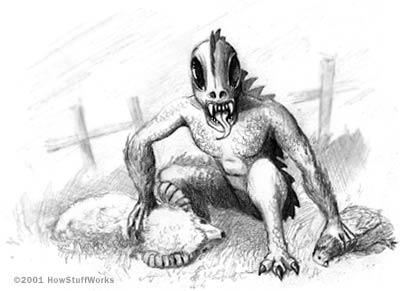
The Spanish translation of "chupacabra" is "goat-sucker." If you remember that means this empty-headed piffling guy sucks on goats, you've nailed information technology.
Chupacabra's main hustle is its vampiric treatment of treasured farm friends. Some tales represent it as a hirsuite, doggish fauna, while others depict it as reptilian. While in that location have been sighting reports of the caprine animal sucker all over the world, the majority originate in South and Central America.
12. Fur-bearing trout
This is a goofy piffling guy you might hear about in Icelandic and American lore. It'south exactly what it sounds like–a little fishy with a fur coat. Why?
To go along warm, to be stylish. Like almost fantasy creatures, the fur-begetting trout has multiple origin stories–from the h2o being then cold that they rapidly evolved, to pilus tonic being spilled in the river. Either way, I recall he's charming.

Do yous have a favorite fantasy fauna? Are you having ideas for how to create your own? Let us know in a comment!
Disclosure: Some of the links above may contain affiliate partnerships, meaning, at no additional cost to you lot, Self-Publishing Schoolhouse may earn a commission if you click through to make a buy.

Source: https://self-publishingschool.com/fantasy-creatures/
Posted by: avalosthics1952.blogspot.com
0 Response to "How To Draw Book With Fantasy Characters Cretures And Animals"
Post a Comment